When does your business need a CRM system?
Most people start thinking about CRM after one simple situation: a customer calls and the manager cannot remember who they are or what was discussed before. A spreadsheet is opened, Telegram messages are searched, and it ends with "let me call you back". That is the moment the sale is lost. A CRM is not "fashionable software for big companies" — it is a way of working built so those situations stop repeating. Below we look at when to introduce one, the difference between a ready-made and a custom system, and what it costs on the Uzbek market.

What problem a CRM actually solves
A CRM's job is to gather all information about a customer in one place and track what happens to every enquiry. Who called, what they asked, which manager replied, what the next step is and when it must happen — all of it is recorded in the system.
The difference is this: in a spreadsheet the data is merely stored, in a CRM it turns into action. The system reminds the manager that "these 7 customers need a follow-up today" and shows the director that "this month 34 of 120 enquiries became contracts".
That is why, when evaluating a CRM, the important question is not "do we have a customer database" but "are we losing any enquiries".
5 clear signs you need a CRM
The first sign is scattered data. The customer list lives in one manager's spreadsheet, in another's phone contacts and in a third person's Telegram chats. When an employee leaves, their customers leave with them.
The second sign is forgotten enquiries. A customer asked for a price, the manager said "I'll calculate and get back to you" and that was that. If this happens regularly rather than once or twice a month, part of the money you spend on advertising is simply being wasted.
The third sign is that management has no real numbers. If the answer to "how was this month?" is "good, livelier than last month", then the sales funnel is not being measured.
The fourth sign is no repeat business. Customers who bought once do not come back, because nobody contacted them in time. Winning a new customer costs several times more than bringing an old one back.
The fifth sign is a growing team. In a team of two, everyone remembers everything. Once you have more than five managers, verbal agreements stop working and the process needs a system.
How long can you keep working in a spreadsheet?
The honest answer: if you get 20–30 enquiries a month and one person handles them, a spreadsheet is enough. In that situation buying a CRM solves the budget, not the problem.
It is easy to tell when the spreadsheet has hit its limit. If two people need to edit the file at the same time, or the question "which file is the latest version?" comes up, or the sheet has grown so large that finding a customer takes minutes — the limit has been crossed.
There is another practical measure: if a manager spends half the day looking for information and preparing reports, half their salary is going into paperwork rather than sales. On that basis a CRM usually pays for itself within a few months.
Ready-made CRM or a custom system?
Ready-made systems (the SaaS solutions on the market) go live quickly and work on a monthly fee. If your sales process is standard — enquiry received, negotiation, contract signed — that option makes sense. The downside: you adapt your process to the software, not the other way round.
A custom CRM is built around your process specifically. That option makes sense for businesses with manufacturing, warehousing, logistics or several departments working together. For example, if an incoming order must automatically reserve stock in the warehouse, create a task for the courier and send the customer a Telegram message — that cannot be configured in a ready-made system.
In our CRM development work we distinguish four directions: sales, manufacturing, service and mixed (sales + service). The process is built differently for each, because a sales manager's working day is nothing like a production supervisor's.
Price and timeline: what to expect
Custom CRM development in Uzbekistan starts at 12,000,000 UZS — an initial set covering the customer database, sales funnel, tasks and core reports. With sales forecasting, a mobile version, VoIP telephony and 1C integration the price sits around 20,000,000 UZS.
A realistic timeline is 60 to 90 days. Most of that time goes not into writing code but into understanding the process: who does what, who decides at which stage, where each piece of information comes from. If that stage is done poorly, the system works technically but the team does not use it.
The exact plans and what they include are listed openly on the pricing page — instead of a vague "depends on the project", you can review the scope of each package up front.
The most common mistake during rollout
The most common mistake is handing the finished system over to the team and walking away. The software works, logins have been issued, but the managers carry on working in spreadsheets out of habit. A month or two later the conclusion is: "CRM didn't work for us".
What did not work was the transition. To avoid it you need to migrate the old data, train the staff and monitor the process during the first weeks. The simpler the interface, the less resistance there is.
The second common mistake is trying to automate everything at once. In practice, starting with the single most painful process and expanding step by step gives far more reliable results.
A real example
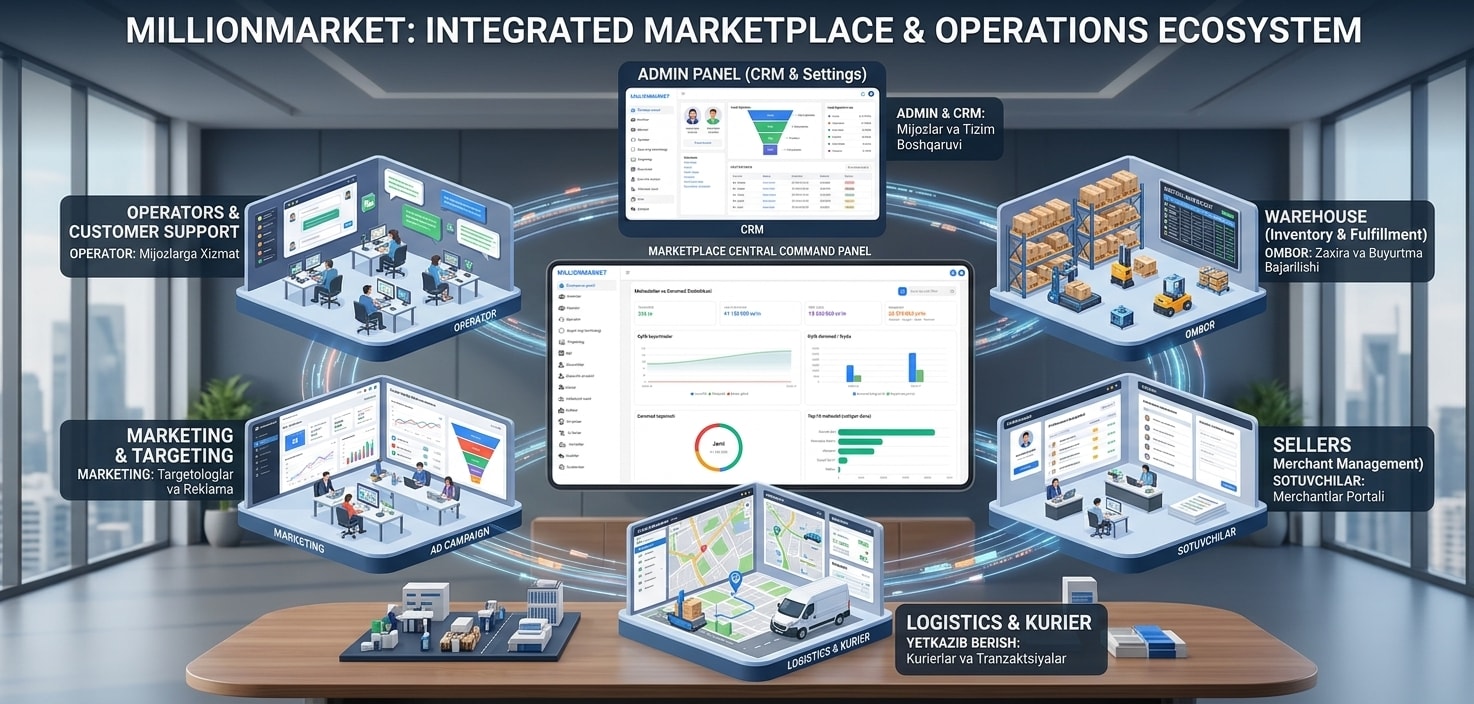
The management system we built for Million Market is a clear example. The problem there was not only the customer database: orders, couriers, operators, media buyers and warehouse processes were managed separately and management could not see the whole picture.
The solution brought every department together in one panel — order status, sales statistics, courier movements and advertising performance became visible in real time. From then on decisions rested on numbers rather than guesses.
If several departments in your business depend on each other too, a simple "customer database" will not be enough — you need a system that connects the processes.
Frequently asked questions
How much does a CRM system cost? A custom CRM starts at 12,000,000 UZS — with a customer database, sales funnel, tasks and core reports. Adding sales forecasting, a mobile version, VoIP telephony and 1C integration brings the price to around 20,000,000 UZS.
How long does a CRM rollout take? A realistic timeline is 60 to 90 days. Most of that time goes into understanding the process rather than writing code: who works how, who decides at which stage.
Does a small business need a CRM? Not always. If you get 20–30 enquiries a month and one person handles them, a spreadsheet is still enough. In that case buying a CRM solves the budget, not the problem.
Ready-made CRM or a custom system? If the sales process is standard — a ready-made system is fast and cheap. If warehousing, manufacturing or several interdependent departments are involved — a custom system, because those connections cannot be configured in an off-the-shelf product.
Why doesn't the team use the CRM after rollout? Usually it is the transition that failed, not the system. Without data migration, staff training and monitoring in the first weeks, managers carry on working in spreadsheets out of habit.
Key Takeaways
- With 20–30 enquiries a month and one manager, a spreadsheet is still enough — no CRM needed
- Scattered data and forgotten enquiries are the two clearest signs you need a CRM
- A ready-made system for a standard sales process, a custom CRM for a distinctive one
- A custom CRM starts at 12M UZS and takes 60–90 days
- Most of the project time goes into understanding the process, not writing code
- Start with the single most painful process rather than automating everything at once
Need advice on your project?
Get in touch with us — we'll provide a free consultation and calculate the project price.
Similar Articles

Opening an online store: how to start selling online for your business
An online store is more than putting products on a website — it becomes a sales channel when the catalog, cart, payments, delivery and admin panel work together. Here is what to prepare, which features you need and where to start selling online.

The 10 most common mistakes in building a corporate website
A corporate website is not just a design exercise. Business goals, user experience, speed and SEO — skipping these core stages costs you results. Here are the 10 most common mistakes and how to avoid them.

Which technology should you choose for a website?
No-code builders, WordPress or modern frameworks (Next.js, React) — which one to pick depends directly on your business goal. Here are the strengths and weaknesses of each.