The 10 most common mistakes in building a corporate website
A corporate website today is far more than a business card on the internet. It signals your company's credibility, is your first contact with customers and is an important marketing tool that brings in new orders. Unfortunately, many companies lose customers and fall short of their goals because of mistakes made while building the site. Below are the 10 most common mistakes in building a corporate website and how to avoid them.

1. Not defining the business goal
Many companies start with the thought "we need a website too". But the site's main job is never defined.
A site might attract new customers, present services, collect enquiries or strengthen the company's reputation. If the goal is not clear, the site will not deliver the result either.
2. Focusing only on a beautiful design
Looks matter, but user experience matters more. If a visitor cannot find the information they need or struggles to get in touch, even the most modern design will not help.
A good corporate website has simple navigation, loads fast, looks right on every device and guides the visitor towards the action you want.
3. Ignoring mobile devices
Today a large share of users view websites on a phone. If the site does not work properly on mobile, visitors leave, enquiries drop and the Google ranking can suffer too.
Responsive design is a mandatory requirement today.
4. Not optimizing site speed
A slow site loses customers. Every extra second worsens the user experience, lowers conversion and hurts SEO results.
Optimizing images, using modern technology and avoiding unnecessary code noticeably improve site speed.
5. Thinking about SEO only after the site is finished
Many companies build the site first and plan SEO later. In reality SEO has to be planned from the start, together with the site architecture, page structure, URLs, metadata and content.
That makes it much easier to rank well on Google later.
6. Having no strong call to action (CTA)
On some sites it is completely unclear what the visitor should do. Every important page should clearly offer one of these actions: get in touch, request a consultation, place an order or request a quote.
A CTA moves the visitor to the next step and noticeably increases conversion.
7. Not adding trust-building elements
A new customer does not know you. That is why it is worth showing completed projects, customer reviews, partner companies, certificates and detailed information about the company.
These raise trust significantly.
8. Neglecting content
A site does not grow on pretty pictures alone. Quality copy matters to Google, answers customer questions and explains your services clearly.
Every page needs useful, original content.
9. Not updating the site after launch
A finished site does not mean the work is over. Publishing blog articles regularly, adding new projects, updating services and carrying out technical optimization all support the site's long-term growth.
10. Not setting up analytics
Many companies never track what happens on their site. Analytics show how many people visit, which pages are popular, where users drop off and which pages bring in the most enquiries.
With that data you can keep improving the site continuously.
Conclusion
Building a corporate website does not end with the design. A well-planned, fast, SEO-ready and user-friendly site becomes an important tool that brings new customers to your business.
If you are planning a corporate website, avoiding the mistakes above will save you time, money and opportunities. A well-built corporate website not only strengthens your company's image but keeps attracting new customers over the long term.
A real example: Picnic Tour — doing it right on a tourism site
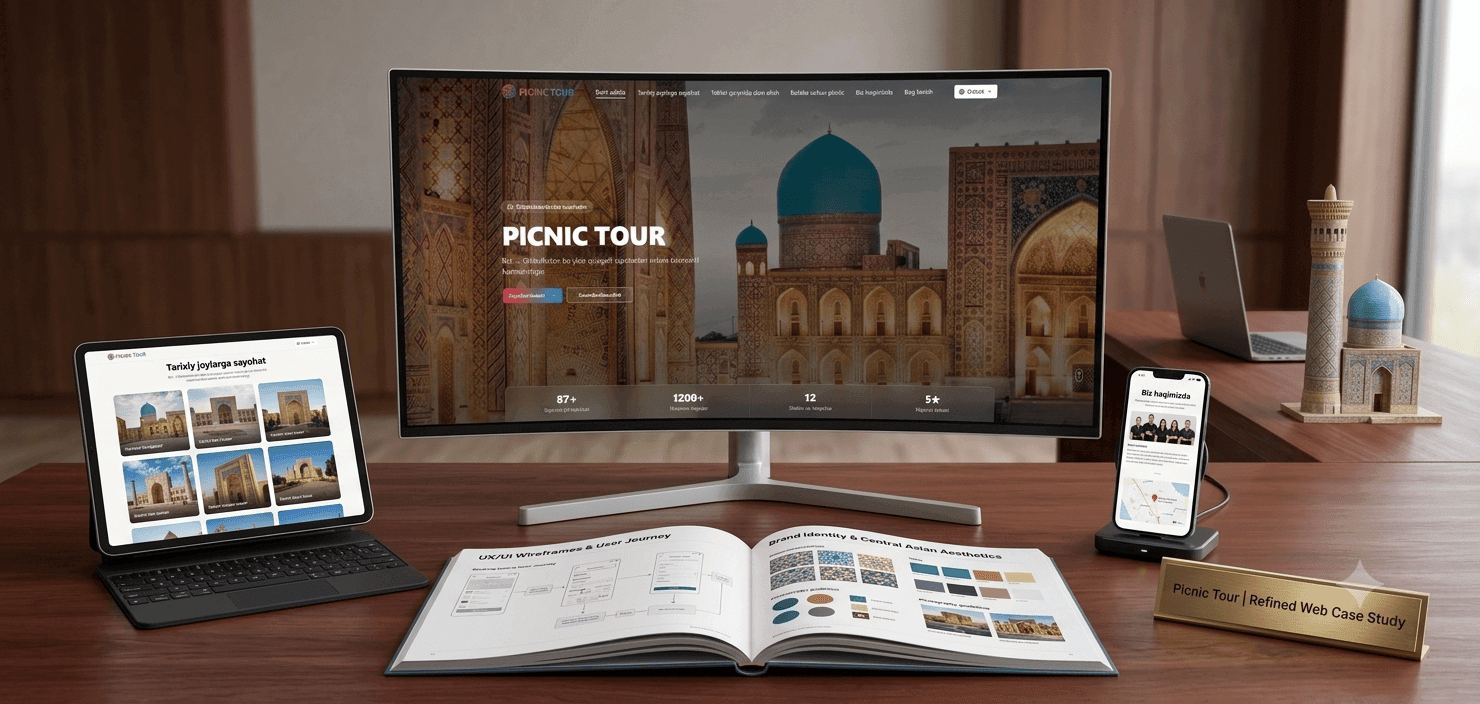
Picnic Tour — a site for booking travel routes across Uzbekistan is a good example of avoiding all the mistakes described above. The site's primary job is clear: attract new bookings across 87+ travel routes. To do that, each route has a detailed description, photos, a price and a well-placed "Book" button — which resolves mistake number 6.
The site is fully comfortable on mobile devices; images of different sizes load correctly from small phone screens upwards and navigation is very simple. Each route includes a short, clear note about guide service, transport and insurance — this addresses the "trust signals" issue in mistake 7. In addition, the site shows 1,200+ happy customers and a 5-star rating.
Another strength: every travel route gets its own page, optimized for SEO and ranking well on Google. Speed matters too: large images and maps load without the site ever feeling slow. In these conditions the site carries the visitor from the first page to the final booking step without friction — a single solution to a set of interconnected mistakes.
Frequently asked questions
How long does it take to build a corporate website? Depending on complexity, it usually takes 2–8 weeks.
When should SEO start for a corporate website? SEO is best planned from the very first stage of development.
Can a finished site be extended later? Yes. A blog, new services, a portfolio and extra features can be added later without difficulty.
Does a small business need a corporate website too? Absolutely. A professional site raises the company's credibility, attracts new customers and strengthens the business's presence online.
Key Takeaways
- If the business goal is not defined up front, the site will not deliver
- Design matters, but user experience matters more
- Working badly on mobile devices loses you visitors
- Optimizing images improves speed considerably
- SEO has to be planned from the start, not at the end
- Every page needs a clear CTA
- Trust signals (projects, reviews) noticeably increase conversion
- Quality content matters for SEO and for customers
- The site needs to keep being updated after launch
- Analytics let you keep improving the site continuously
Need advice on your project?
Get in touch with us — we'll provide a free consultation and calculate the project price.
Similar Articles

Which technology should you choose for a website?
No-code builders, WordPress or modern frameworks (Next.js, React) — which one to pick depends directly on your business goal. Here are the strengths and weaknesses of each.

Landing page or corporate website: which should you choose?
Are you selling one product or presenting your whole company? Those two questions decide the choice between a landing page and a corporate website.

Opening an online store: how to start selling online for your business
An online store is more than putting products on a website — it becomes a sales channel when the catalog, cart, payments, delivery and admin panel work together. Here is what to prepare, which features you need and where to start selling online.