Which technology should you choose for a website?
Most people ordering a website start the conversation with design: what colours, what goes on the homepage. The technology question is left to the developer with a "you decide that". The problem is that this very choice determines how fast the site opens, how it ranks on Google and how much adding a new feature will cost a year from now. Below we look at three main directions — no-code builders, WordPress and modern frameworks — with their strengths and weaknesses.

What the technology choice actually affects
First, speed. If a site takes more than 3 seconds to open, a significant share of visitors leave without waiting. Google also counts page speed (the Core Web Vitals metrics) among its ranking factors, so a slow site ranks lower in search as well.
Second, room to grow. A simple business-card site may be enough today, but what happens in a year when you need online payments, warehouse integration or a multilingual version? On some platforms that is simply impossible — you have to rebuild the site from scratch.
Third, the cost of ownership. A project that starts cheap can end up more expensive over time through monthly subscriptions, plugin licences and constant fixes.
No-code builders (Tilda, Wix and similar)
Their main strength is speed and low cost. You can have a finished page in a few days, no programming knowledge is required and you swap text and images yourself.
The limits are just as clear. The design never leaves the template, you cannot control the site's code and speed depends on the platform's shared server. SEO capabilities are limited to whatever the platform allows.
One more thing: the site is not yours, it is rented on the platform. Stop the subscription and the site goes down, and moving the content elsewhere is usually not easy.
The verdict: fine for a one-page event site, a personal portfolio or quickly testing an idea. As a business's main website it does not go far.
WordPress
A large share of the world's websites run on WordPress, and for good reasons: thousands of ready-made themes, a plugin for almost any task and a convenient panel for managing content yourself.
The trouble usually starts with plugins. Every plugin is extra code, extra requests and a potential vulnerability. A site with 15–20 plugins slows down noticeably, and if one of them stops being updated it turns into a security hole.
That is why WordPress is not an "install it and forget it" solution — the core, theme and plugins need regular updates and backups. Someone has to be responsible for that work.
The verdict: a logical choice for a blog, news site or simple catalog with frequently updated content, especially if you want to manage the site yourself.
Modern frameworks (Next.js, React)
With this approach the site is built from scratch to your requirements rather than on top of a ready template. Thanks to server-side rendering (SSR) and static generation (SSG), the page reaches the user almost fully prepared — which makes a noticeable difference to speed.
It is convenient from an SEO point of view too: every page's metadata, structured data (JSON-LD) and URL are fully under your control. A multilingual site, complex filters, integration with external systems — all of it can be done without limits.
To be fair, there are downsides: development takes more time and budget than a builder, and changing the content structure needs a developer (although with an admin panel, day-to-day content management stays independent).
The verdict: if the site is the business's main channel, if traffic is growing or if it needs to connect to other systems — this is the most sensible choice long term.
A practical rule: how to choose
Start with a simple question: how does this site make the business money? If the answer is "it should just have information about the company", you do not need a complex solution. If the answer is "customers order from here", the technology deserves serious thought.
The second question: which features might you need in a year? If payments, customer accounts or a CRM connection are on the roadmap, it is better to pick a foundation that is ready to grow from the start.
As a budget guide: a landing page starts at 3,000,000 UZS and takes 7–10 days, a corporate website starts at 8,000,000 UZS and takes 14–30 days, and an online store starts at 15,000,000 UZS and takes 30–45 days. The full scope and plans are listed openly on the pricing page.
A real example: a high-traffic site
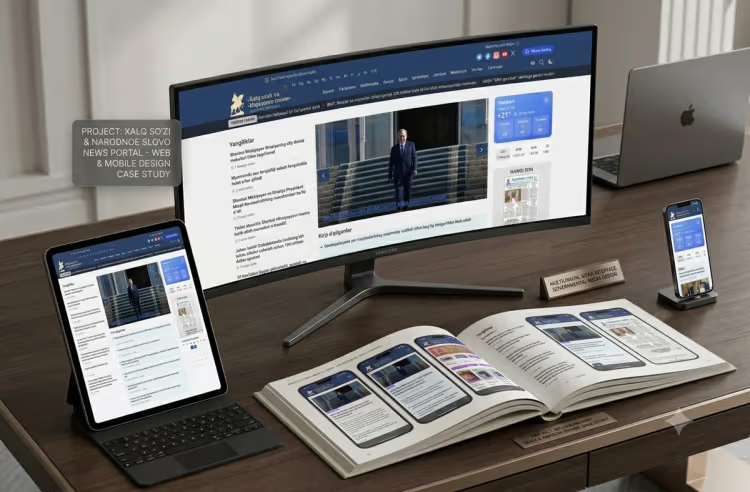
The portal we built for the «Xalq So'zi» newspaper shows well how much the technology choice matters. The requirements there were strict: work in 13 languages, handle high daily traffic and open fast on mobile devices.
In those conditions neither a builder nor a plugin-heavy WordPress would have coped. The project was built on Next.js — pages are generated in advance, so the site does not slow down even when readership spikes.
The same rule applies to smaller projects: choose technology for where you will be in two years, not for today's needs. Switching platforms later always costs more than choosing correctly at the start.
Frequently asked questions
Which technology gets a site live fastest? A no-code builder — you can have a finished page in a few days. But you pay for that speed with design, code control and SEO capabilities, so it is not recommended as a main business website.
Is WordPress still a good choice? For a blog, news site or simple catalog with frequently updated content — yes. But it is not an "install it and forget it" solution: the core, theme and plugins need regular updates and someone has to own that.
Isn't Next.js overkill for a small business? The question is not about the technology but about the site's job. If the site is just information about the company — it is overkill. If customers order from it or traffic is expected to grow — it is a justified choice.
Can a site be moved to another technology later? Technically yes, but in practice it almost always costs more than building from scratch. That is why the choice should be based on where you will be in two years, not today.
Does technology affect SEO results? Yes, in two ways: page speed (a Core Web Vitals ranking factor) and the degree of control over metadata, URLs and structured data.
Key Takeaways
- The technology choice determines speed, SEO and the future cost of expansion
- No-code builders suit one-page or trial projects, not a main business website
- WordPress suits sites with frequently updated content but needs continuous maintenance
- A framework like Next.js suits projects with growing traffic and integration needs
- A landing page starts at 3M UZS (7–10 days), a corporate website at 8M UZS (14–30 days)
- Base the choice on where you will be in two years, not on today
Need advice on your project?
Get in touch with us — we'll provide a free consultation and calculate the project price.
Similar Articles

The 10 most common mistakes in building a corporate website
A corporate website is not just a design exercise. Business goals, user experience, speed and SEO — skipping these core stages costs you results. Here are the 10 most common mistakes and how to avoid them.

Landing page or corporate website: which should you choose?
Are you selling one product or presenting your whole company? Those two questions decide the choice between a landing page and a corporate website.

Opening an online store: how to start selling online for your business
An online store is more than putting products on a website — it becomes a sales channel when the catalog, cart, payments, delivery and admin panel work together. Here is what to prepare, which features you need and where to start selling online.