What is the difference between an AI agent and a regular chatbot?
The two terms have become so mixed up on the market that what many proposals call an "AI chatbot" turns out to be an ordinary button-driven bot. Knowing the difference has practical value: one goes live in a few days for 3M UZS, the other takes several weeks and starts at 10M UZS. The wrong choice hurts either way: overspending on a simple task, or deploying something inadequate for a complex one.

A rule-based chatbot: how it works
This kind of bot follows a script written in advance. The user is shown buttons — "Products", "Prices", "Contact" — picks one, and the bot returns the answer attached to that button. There is no "understanding" inside, only the logic of "if this button is pressed, show this text".
Its strength is predictability. The bot never invents an answer, because it only outputs text you wrote. For information where mistakes are unacceptable — bank details or delivery terms — that matters.
Its weakness follows from the same thing: if the user steps outside the buttons and writes a question in their own words, the bot cannot answer. If "where is my order from yesterday?" is not in the script, the conversation stops.
In practice this option works for taking orders, giving opening hours and an address, simple FAQs and handing over to an operator. Such a Telegram bot starts at 3,000,000 UZS and usually goes live within a few days.
An AI agent built on LLM and RAG: how it works
An AI agent is built on a different principle. It understands a freely written question and composes the answer not from prepared text but from your knowledge base. The technology is called RAG — Retrieval-Augmented Generation, i.e. "find it first, then write the answer".
It works like this: a question arrives, the system determines its meaning, searches the document base (product descriptions, internal rules, price lists) for the most relevant passages, and writes an answer based only on what it found. That is why the answer is grounded in documents rather than "made up".
An important technical point: without RAG, a language model can invent an answer (a phenomenon known as hallucination). For a business that is an unacceptable risk — which is why grounding in a knowledge base is mandatory in serious projects.
An AI agent can do one more thing: it remembers the conversation context. If the user writes "how much does it cost?", the agent works out from previous messages what "it" refers to. A button-driven bot has no such capability.
A real example: an AI agent for a bank
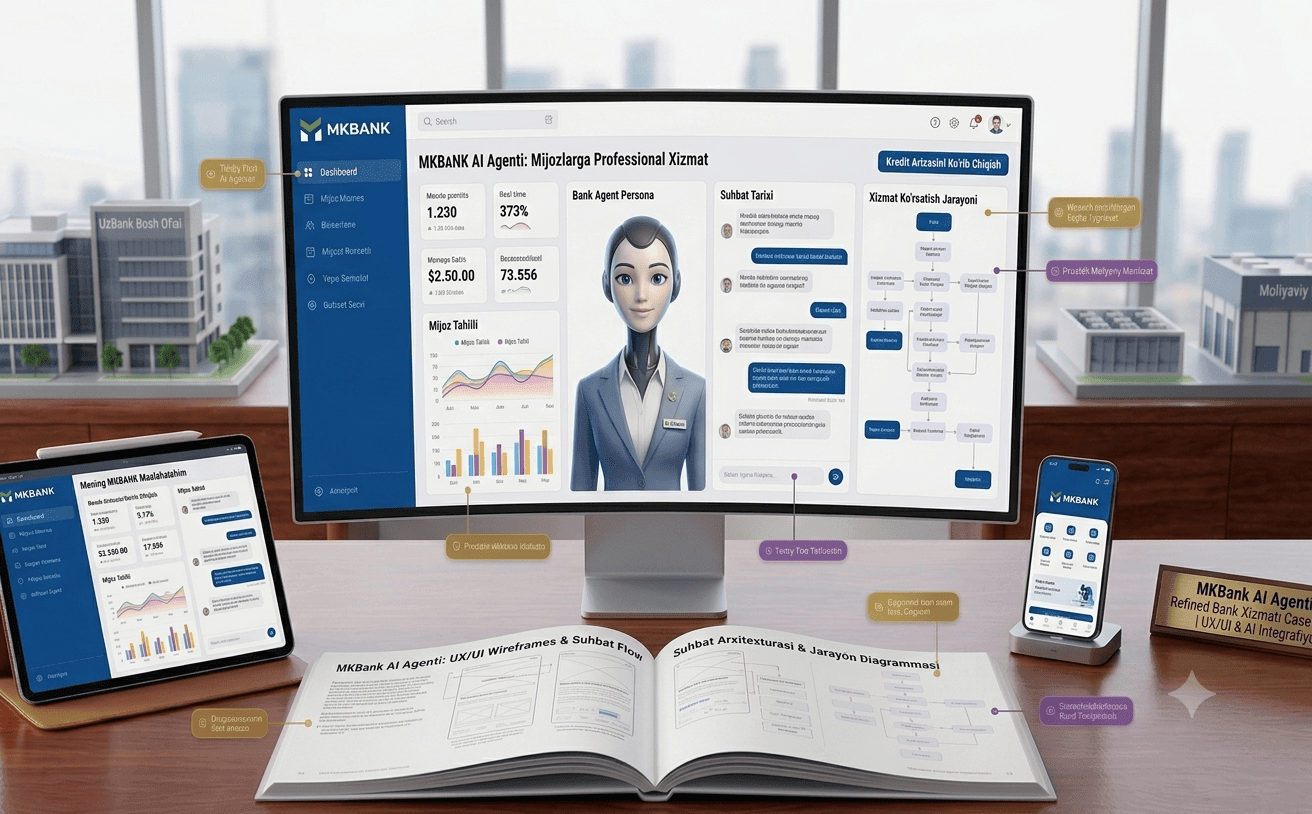
The AI agent we built for a bank shows this difference well. It answers questions about loan products, cards, deposits, payments and mobile app issues — topics far too varied to fit into buttons.
The system has several stages: identifying the type of question, searching the knowledge base, clarifying the question, keeping multi-turn conversation context, a safety check and answer validation. Where needed the agent hands the conversation to an operator or creates a ticket.
Security was built in separately: the agent never asks for a PIN, CVV or OTP code, and when something resembling fraud is detected it automatically returns a safe response. Constraints like these do not appear on their own in an ordinary chatbot or in unconfigured AI — they are designed deliberately.
Which to choose: practical criteria
First question: can you write out the list of customer questions in advance? If yes, and the list does not exceed 20–30 questions, a button-driven bot is enough. There is no need to overcomplicate.
Second question: does answering require reading a document? For example, if a customer asks "how many months of warranty are in this contract?" and the answer sits inside a 40-page document — that is a job for an AI agent.
Third question: what is the volume of enquiries? At 10–20 questions a day an operator copes comfortably. At hundreds a day, most of them repetitive, automation saves real money.
As a budget guide: a button-driven Telegram bot starts at 3M UZS, an AI agent at 10M UZS. There is also a hybrid option, which is often the most sensible: frequent questions handled through buttons, the rest through AI.
What to be prepared for
An AI agent is not an "install it" product. Its quality depends directly on the quality of the knowledge base: if your documents are outdated or confusing, the answers will be too. At the start of the project much of the time goes into organizing that information.
Monitoring is needed after launch too: which questions the agent could not answer, where it referenced the wrong document. Reviewing that log in the first months and topping up the knowledge base improves results noticeably.
One last piece of advice: do not hand the agent everything at once. Starting with one clear area (product questions only, for example) and expanding once you are confident is far safer.
Frequently asked questions
How much do an AI agent and a chatbot differ in price? A button-driven Telegram bot starts at 3,000,000 UZS, an AI agent at 10,000,000 UZS. The gap is large, so defining the task up front matters.
Which one do I need? If you can write out the list of customer questions in advance and it does not exceed 20–30 — a button-driven bot is enough. If the answer sits inside a 40-page document and has to be found — that is a job for an AI agent.
Can an AI agent give a wrong answer? RAG technology exists precisely to prevent that: the agent does not invent the answer, it finds it in your documents. But if the documents are outdated or confusing, the answers will be too.
What is needed to launch an AI agent? First of all an organized knowledge base — documents, prices, terms. At the start of the project most of the time goes into exactly that, not into writing code.
Can both be used together? Yes, and it is often the most sensible option: frequent questions are handled quickly through buttons, while complex, free-form questions go to the AI.
Key Takeaways
- A chatbot follows a prewritten script; an AI agent understands a free-form question
- RAG is the technology of finding the answer in your documents instead of inventing it
- If you can write out the list of questions in advance, a button-driven bot is enough
- If the answer sits inside a 40-page document, that is a job for an AI agent
- A Telegram bot starts at 3M UZS, an AI agent at 10M UZS
- An AI agent is only as good as its knowledge base — organize the documents first
Need advice on your project?
Get in touch with us — we'll provide a free consultation and calculate the project price.
Similar Articles

Opening an online store: how to start selling online for your business
An online store is more than putting products on a website — it becomes a sales channel when the catalog, cart, payments, delivery and admin panel work together. Here is what to prepare, which features you need and where to start selling online.

The 10 most common mistakes in building a corporate website
A corporate website is not just a design exercise. Business goals, user experience, speed and SEO — skipping these core stages costs you results. Here are the 10 most common mistakes and how to avoid them.
Which technology should you choose for a website?
No-code builders, WordPress or modern frameworks (Next.js, React) — which one to pick depends directly on your business goal. Here are the strengths and weaknesses of each.